Introduction
Students often get pulled in many different directions in school. Lectures, assignments, tuition, sports, and friends all compete for a student's day.
Time management is not just a fixed schedule. It is the habit of planning, prioritising, and finishing the tasks that matter most.
Understanding why time management matters for students can shift them from cramming to steady progress and support their well-being.
Key Takeaways
- Having a consistent approach to studying through regular planning can replace the need for cramming.
- Poor Time Management increases stress and makes it difficult to focus.
- Basic frameworks work best for every age group.
- Keeping up with a quick weekly check-in will keep your habits on track.
- Tools like planners and apps can make time management easier.
Why Is Time Management Important for Students?
Modern academic demands and digital distractions require structure instead of memory alone.
If students have a plan, they know what to do. If they don’t, they may waste time making decisions and getting very stressed.
Planning moves students from simply being busy to getting real results and remembering what is learnt.
Being busy is not the same as being productive. Doing 2 hours of focused work can be more productive and often beat 5 distracted hours.
The Impact of Poor Time Management on Students
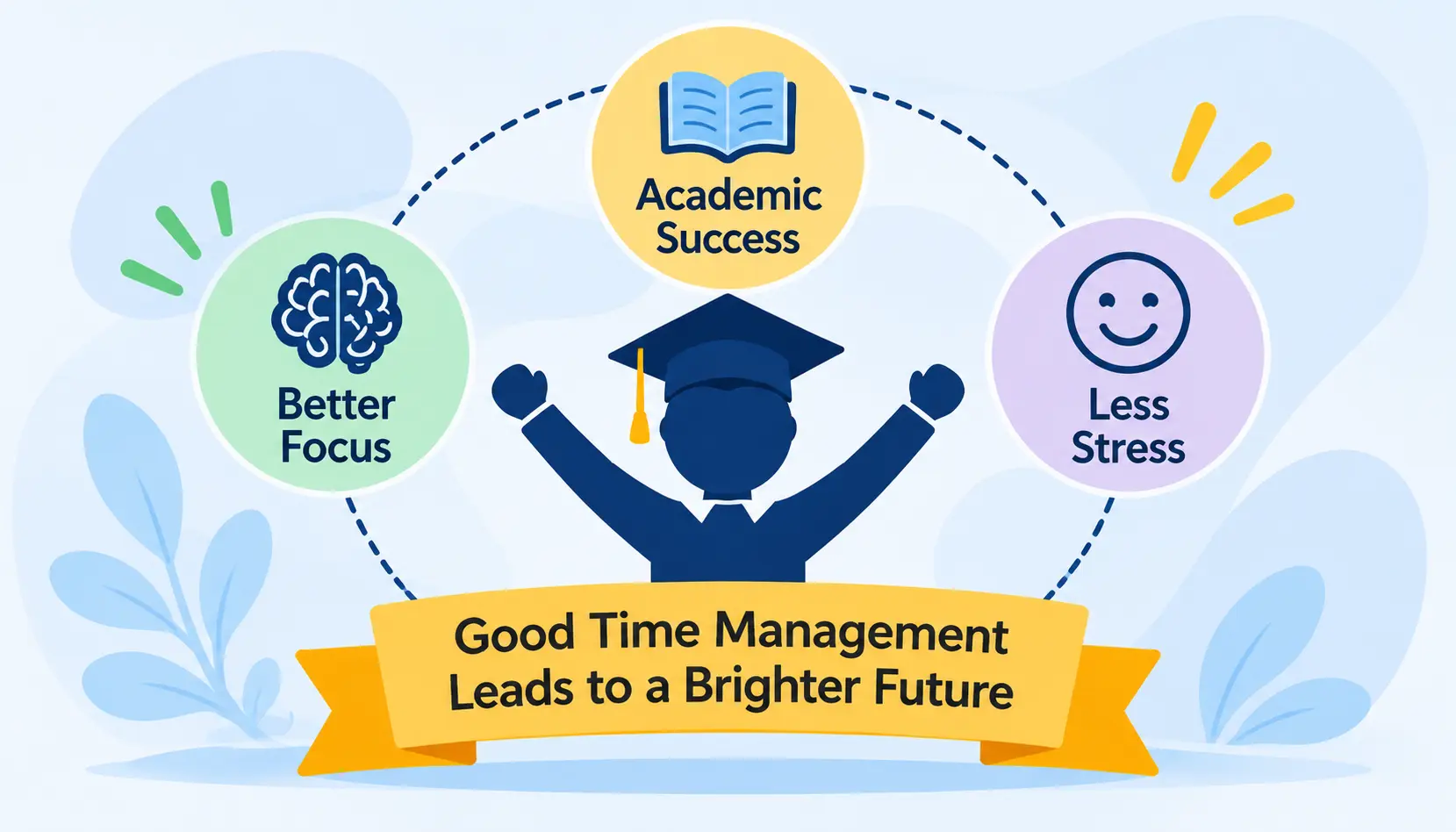
When students avoid tasks, they rush, submit weak assignments, and feel constant panic. However, if students rush with their tasks, it will lead to exhaustion, poor sleep, and low concentration.
Procrastination creates a negative cycle. As tasks pile up, panic increases, and the work submitted may not show the true ability of the student.
In a survey of Grand Canyon University, it was found that approximately 50.5% of students study less than 2 hours per day on average.
Overcommitment adds to the problem. By joining too many clubs and attending too many classes, students may not leave time to rest, and tired minds learn slowly
Benefits of Time Management for Students
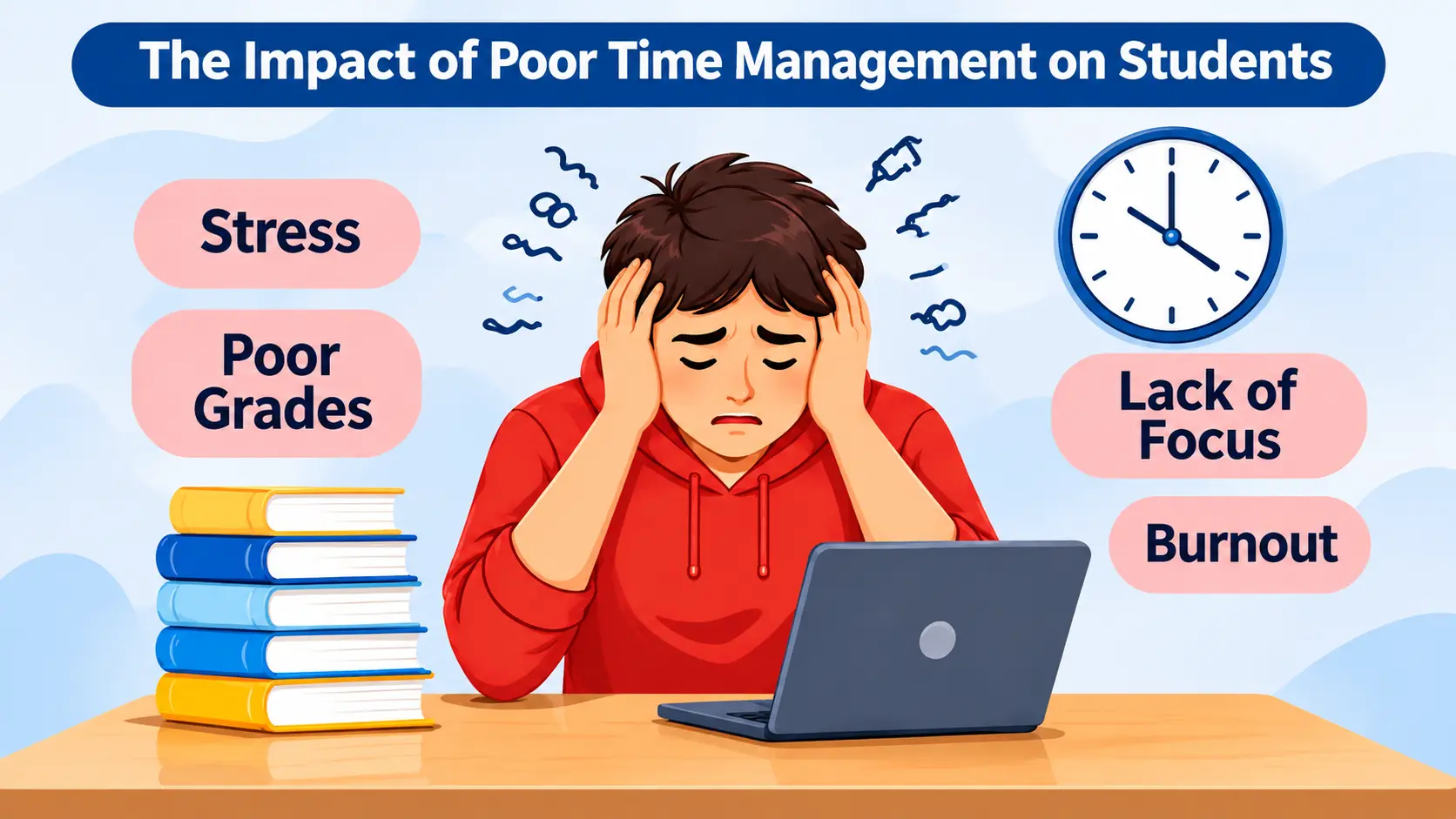
Academic gains
- Improved retention of knowledge: Instead of cramming, spaced learning will build lasting understanding of concepts.
- Improved focus: Focusing on one task at a time will reduce switching between tasks and train the mind to stay with one subject.
Wellbeing
- Less stress: Having a clear plan releases anxieties, as students are well-informed about their next activity.
- Balance: Students can include physical activity, hobbies, and social time in their day, without falling behind in class.
Career skills
- Improved decision-making: Students will learn daily to identify what is important and what is urgent.
- Increased confidence: Punctuality, reliability, and high-quality work will earn the trust of teachers and, later, employers.
How to Manage Time as a Student at Every Age
- Primary School Students: Having simple morning routines and structured play will build security and form self-discipline.
- Middle School Students: Weekly planners can help to balance growing assignment loads, sports and social activities and also helps reduce procrastination.
- High School Students: Good time management is needed in semester planning, exam preparation, and part-time work.
Sunshine Worldwide School is an international school in Goa that offers both IB and CBSE curricula. With a child-centred, inquiry-based, holistic, and future-ready approach, children can develop these habits early.
Sunshine Worldwide School's “responsibility over discipline” philosophy lets children take ownership of their decisions and manage their own day. Through student-led activities and cultural fests, children can really put these planning and delivering skills into practice.
Time Management Strategies for Students
- Eisenhower Matrix: Divide tasks into urgent and important, important but not urgent, urgent but not important, and neither.
- Pomodoro Technique: Work for 25 mins, then take a break for 5 mins to avoid fatigue.
- 3/3/3 rule: One 3-hour main task, three medium tasks, and three small chores each day.
- 80/20 principle: find the 20% of study effort to get 80% of results in test results.
- 7/8/9 balance: 7 hours for sleep, 8 hours of study/work, and 9 hours for personal time and rest.
- 5Ps: Plan, prioritise, prepare, perform & pause/perfect.
How to Improve Time Management for Students
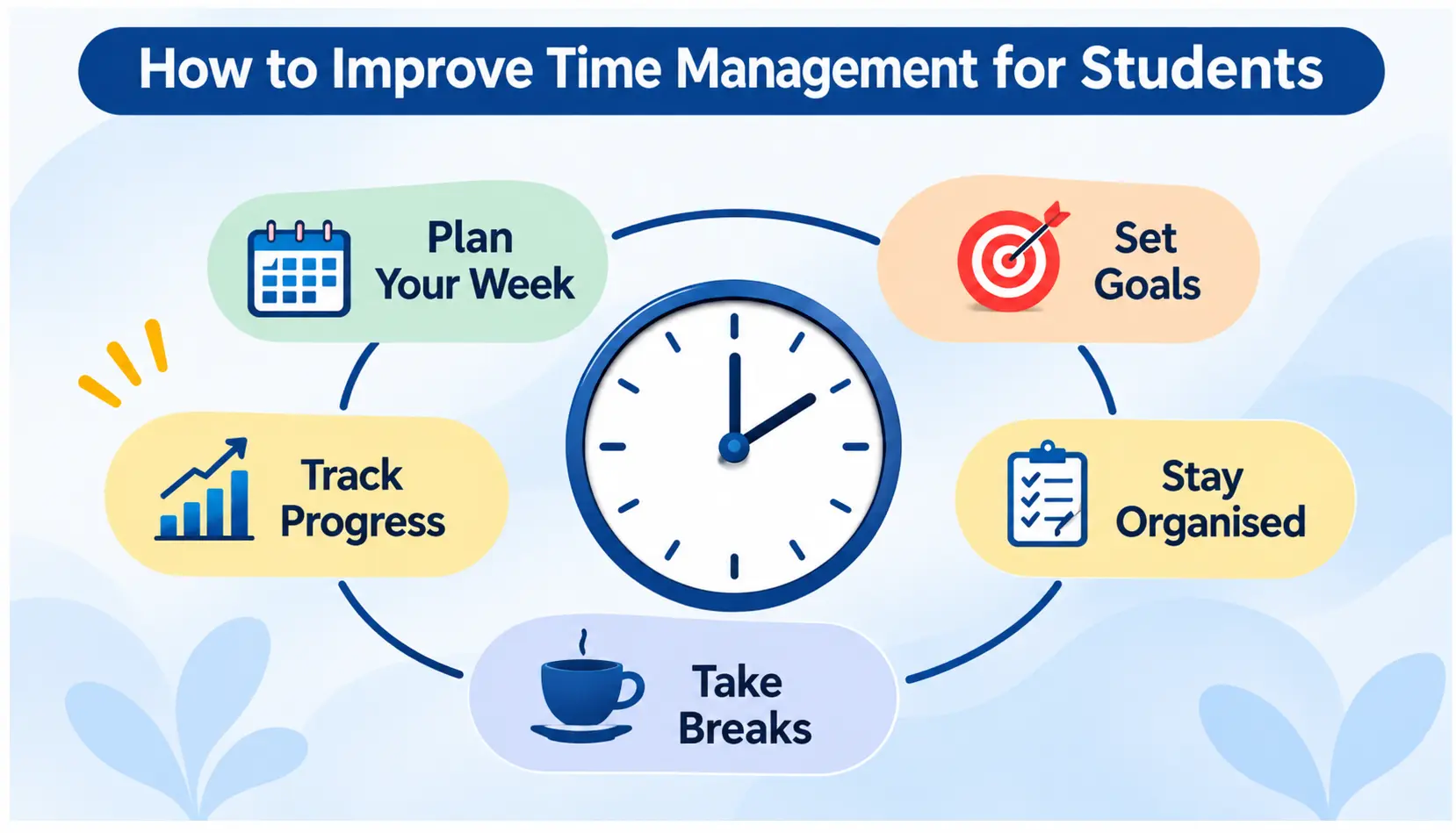
- Audit your week: Track how much time is spent on social media and gaming, then reclaim those hours.
- Set SMART Goals: For example, turn "study maths" into "solve 10 algebra problems by 6 PM".
- Break projects down: Break large projects into smaller pieces. For example, a 20-page research paper becomes 2 pages a day, which will reduce overwhelm.
- Use tools: Try Google Calendar, Trello, Notion, and Forest. These can be useful to pair with a paper planner.
- Review on Sundays: Complete a weekly review on Sundays. Spend 15 minutes editing and celebrating small achievements.
Summary
Time management for students can lead to steady learning, less stress, and a good balance between studying and relaxing/doing hobbies. In this guide, we’ll look at the importance of time management for students, how poor time management can affect students, and some management techniques for students of all ages.
Conclusion
Good time management gives students more control. It allows them to make progress without stress and leaves room for relaxation, fun, and curiosity in their lives.
Try one time management technique this week, track it, and adjust. Over time, developing these time management strategies will create habits that last well beyond school.
Frequently Asked Questions
1. Why is time management important when preparing for board exams in Class 10 and 12?
Board exams have a very long syllabus. A steady plan helps students avoid cramming and eases anxiety.
2. What are the most common time management mistakes students make?
Procrastination, overcommitting, distractions from technology, and skipping breaks.
3. How can parents encourage consistent study habits in their children without being pushy?
Break work into smaller daily tasks and set up a quiet study space. Using planners or alarms can also be a non-pushy way to remind students to study.
4. What is the 5 Ps framework for effective time management?
Plan, Prioritise, Prepare, Perform, and Perfect (or Pause). This helps students prioritise tasks to improve their time management.
5. How can effective time management prevent student burnout?
With planned study times and breaks, students avoid overworking and make time for rest and hobbies.