Introduction
A lot of people think that school education is only about passing exams. But if you look closely at how CBSE structures its curriculum and how we apply it at Sunshine Worldwide School in Old Goa, you will notice that it is really about building strong foundations that stay with a child for life.
Key Takeaways
- CBSE lays down a foundation at an early stage, so students begin with simple ideas and gradually move towards complex ideas without sudden pressure.
- The subjects are interrelated not only among themselves but with the outside world too.
- Environmental Studies starts at an early stage, making learners aware and responsible.
- Middle school sharpens students' structured thinking for higher classes.
- Strong early foundations help students prepare better for board exams by class 9-10.
Building the Basics Right From the Primary Years
From the primary years themselves, CBSE focuses on getting the basics right. Subjects like Mathematics, Science, and Languages are taught step by step, building on what was learned the year before. This means a child is not thrown into difficult topics suddenly. Instead, they move from simple ideas to harder ones gradually, which makes learning less stressful and more natural.
Our teachers in the primary section pay close attention to this pacing, making sure every child, regardless of how quickly or slowly they grasp a concept, gets the support needed to move forward confidently.
This early emphasis on fundamentals is a national priority, and not just a school-level preference. The NIPUN Bharat mission of the Ministry of Education is focused on ensuring that every child is able to achieve foundational literacy and numeracy by the end of grade 3, with an objective of completion by 2026-27, as it is in these initial years that one lays the foundation for everything that follows.
Connecting Concepts Across Subjects
One of the biggest strengths of the CBSE curriculum is how it connects concepts across subjects. For example, what a child learns in Science about measurement links back to what they learn in Math, and what they learn about their environment often connects to Goa's own rivers, forests, and coastline.
This connection helps children understand that subjects are not separate boxes but are related to each other and to the real world around them, including the world they see every day in Old Goa.
This unified strategy is a deliberate design choice also at the national level. The NCERT's National Curriculum Framework for School Education 2023 calls for a multi-disciplinary, holistic, and integrated learning approach, instead of teaching each subject in isolation.
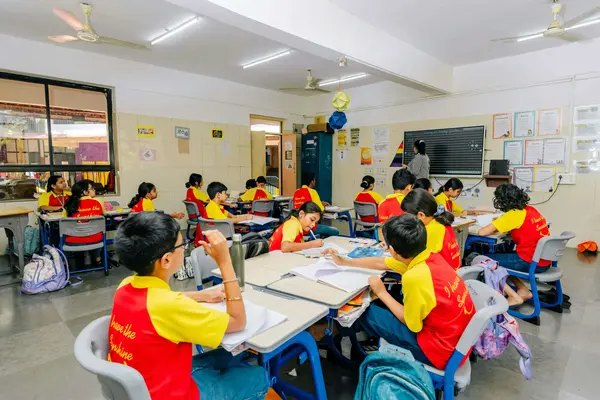
Environmental Studies and Community Awareness
CBSE also puts a good amount of focus on Environmental Studies and general awareness in the early years. Children are taught about nature, health, safety, and community life simply.
Given that Old Goa is home to rich biodiversity, heritage sites, and a strong sense of local history, Sunshine Worldwide School is able to bring these lessons alive through field visits and hands-on activities, helping children become more aware and responsible from a young age, not just book-smart.
Structured Thinking in the Middle School Years
As students move into middle school, the curriculum starts introducing more structured thinking. Concepts in Math and Science become more detailed, and subjects like Social Science help children understand history, geography, and civics in a connected manner.
Studying in Goa, with its unique Indo-Portuguese history and coastal geography, gives our students a living example of many concepts they read about, from colonial history to coastal ecosystems and trade routes. This stage is important because it prepares the mental habits needed for higher classes.
A Strong Base Going Into Class 9 and 10
By the time students reach Class 9 and 10, the CBSE curriculum has already built a strong base. This is why students who have followed the syllabus properly from the start usually find it easier to handle board exam pressure.
They are not learning everything from scratch; they are simply building on years of steady preparation, supported by teachers who know them well and track their progress closely.
The same pattern is observed across the world. The World Bank notes that early learning lays the groundwork for literacy, numeracy, and socio-emotional skills, which, in turn, serve as the building blocks for learning other skills as well.
This is exactly why having a steady foundation in early education makes learning easier later in life, rather than harder.
The Role of Teachers in Tracking Progress
Teachers also play a big role here. CBSE schools are expected to follow structured lesson plans and regular assessments, which means a child's progress is tracked closely, and gaps in understanding can be caught early.
At Sunshine Worldwide School, our smaller class sizes and close-knit school community mean that no child is left behind, and every gap in learning is noticed and addressed quickly.
Conclusion
In the end, the real benefit of the CBSE curriculum is not just about exam scores. It is about giving children a strong, connected, and steady base of knowledge that supports them not just in school, but in whatever they choose to do afterward, whether that is higher studies, competitive exams, or simply becoming a well-informed adult who understands and appreciates the world, starting with the one right around them in Old Goa.
FAQs
What is the reason for CBSE's emphasis on primary years?
The early years lay the groundwork for strong literacy and numeracy, helping children develop fundamental skills by Class 3.
How does CBSE connect different subjects?
Subjects are interrelated so that children can apply concepts across Math, Science, and real-life situations.
What is the importance of Environmental Studies in CBSE?
Environmental Studies in CBSE is important as it teaches children about nature, health, safety, and their surroundings at a young age.
Is a strong foundation beneficial in board exams?
Yes. Having a strong foundation makes Class 9 and 10 studies, along with board exams, easy to manage.
Is the CBSE curriculum uniform across all schools in India?
Yes, the syllabus is uniform throughout the country, allowing for smoother transitions between schools.
References
- Ministry of Education, Government of India, via PIB, NIPUN Bharat launch: https://www.pib.gov.in/Pressreleaseshare.aspx?PRID=1732830
- NCERT, National Curriculum Framework for School Education 2023: https://ncert.nic.in/pdf/NCFSE-2023-August_2023.pdf
- World Bank, Education and Skills overview: https://www.worldbank.org/en/topic/education/overview